

Apps reference
Per-app settings, environment variables, data access, backend versions, and limits for Keboola apps.
Technical reference for building and running Keboola apps — the settings, variables, and runtime behavior you’ll reach for while developing.
On this page: Environment variables · Data access · Backend versions · App actions · Sleep and resume · Limits
Per-app settings
Section titled “Per-app settings”Each app has its own configuration.
| Setting | What it does |
|---|---|
| Authentication | Who can open the app — None, Basic, OIDC, GitHub, GitLab, or JumpCloud. See Authentication. |
| Code Source | Where the app’s code comes from — inline Code or a Git Repository. |
| Backend version | The runtime image (Python version and, for Streamlit, the Streamlit version). See Backend versions. |
| Backend size | The compute allocated to the app (for example XSmall, Small); chosen on deploy. |
| Auto-sleep | The inactivity timeout before the app suspends. See Sleep and resume. |
| URL | The address where the app is served. |
| Versioning | Draft vs production versions of the app, on the Versions tab. |
Environment variables
Section titled “Environment variables”Sensitive values — API keys, tokens, passwords — should be stored as secrets in the app configuration, never written into your code. The platform also injects several variables automatically: BRANCH_ID (always set), KBC_TOKEN and DATA_LOADER_API_URL (with Data Loader), and WORKSPACE_ID / QUERY_SERVICE_URL / KBC_WORKSPACE_MANIFEST_PATH (with Storage Access). See the runtime README for the full list.
| Variable | Notes |
|---|---|
KBC_TOKEN | Storage token, injected automatically. Reserved — do not set it yourself, and keep it server-side. |
KBC_WORKSPACE_MANIFEST_PATH | Path to the workspace manifest JSON file (contains workspaceId). Recommended source for the workspace ID. Set with Storage Access. |
WORKSPACE_ID | ID of the provisioned workspace. Also in the manifest — prefer the manifest in new code. Set with Storage Access. |
BRANCH_ID | Storage API branch ID of the project. |
QUERY_SERVICE_URL | URL of the Query Service API (stack-specific). Set with Storage Access. |
Secrets
Section titled “Secrets”Add secrets as key-value pairs in the app configuration. The # prefix marks a value as a secret (encrypted at rest). Keboola makes secrets available as environment variables when your app starts: the # prefix is stripped and the variable name is uppercased. For example, #my-custom-var becomes MY_CUSTOM_VAR — the # is removed, dashes become underscores, and the name is uppercased. The value itself is passed through unchanged.
Runtime and language support
Section titled “Runtime and language support”Backend versions since 1.15.0 are available in multiple Python variants:
| Python Version | Notes |
|---|---|
| 3.10 | Default. Most widely compatible with third-party packages. Recommended if you are unsure. |
| 3.11 | Faster execution in many workloads (10–60% speedup over 3.10). Good balance of compatibility and performance. |
| 3.13 | Latest stable Python release. Best performance and newest language features, but some packages may not yet support it. |
Backend versions
Section titled “Backend versions”When deploying an app, you can select a backend version from a dropdown in the deployment wizard. Each backend version defines the runtime environment, including the Python version, Streamlit version, and a set of pre-installed packages.
Each backend version is displayed in the following format:
<backend_version> - Python <python_version> + Streamlit <streamlit_version>For example: 1.15.2 - Python 3.13 + Streamlit 1.51.
- Backend version (
1.15.2): The release version of the base Docker image that powers your app. - Python version (
3.13): The version of the Python interpreter. - Streamlit version (
1.51): The version of the Streamlit framework used to run your app.
Pre-installed packages
Section titled “Pre-installed packages”All backend versions ship with the same set of pre-installed packages regardless of the Python variant. These are available immediately without adding them to the Packages field or requirements.txt:
streamlitpandasnumpymatplotlibplotlyscikit-learnseaborngraphvizdeepmergepython-dotenvkeboola.componentstreamlit-aggridstreamlit-keboola-apistreamlit_authenticator(pinned to 0.3.1)toml
To add packages beyond this list, specify them in the Packages field (for code deployment) or in a requirements.txt file (for Git repository deployment).
Data access
Section titled “Data access”Apps read and write Keboola data three ways: a one-time load via Input Mapping, on-demand reads via the Storage API, and real-time SQL via Storage Access.
Input Mapping
Section titled “Input Mapping”If you configure Input Mapping, Keboola loads selected tables into the container before your app starts. Read them as CSV files:
import pandas as pd
# File path pattern: /data/in/tables/<table-name>.csvdf = pd.read_csv("/data/in/tables/my_table.csv")
Input Mapping data is loaded once at startup. To get fresh data, redeploy the app or use the Storage API at runtime.
Storage API at runtime
Section titled “Storage API at runtime”To fetch up-to-date data without redeploying, use the Keboola Storage API. Exporting a table is an asynchronous job, so use the official client rather than calling the endpoint by hand — it handles the export job, download, and paging for you:
import osimport pandas as pdfrom kbcstorage.client import Client
client = Client(os.environ["KBC_URL"], os.environ["KBC_TOKEN"])  # KBC_TOKEN is injected automatically
client.tables.export_to_file(table_id="in.c-main.my_table", path_name=".")df = pd.read_csv("my_table")
For the full API, see the Keboola Storage Python Client documentation.
Storage Access
Section titled “Storage Access”Storage Access lets your app read from and write back to Keboola Storage tables in real time, over SQL through the Query Service.
Enable it: in Project Settings > Features, activate Storage Access. Then, in the app’s Advanced Settings > Storage Access, click + Add Writable Table and select the buckets/tables the app may read and write (SELECT, INSERT, UPDATE, DELETE, TRUNCATE). All selected tables must exist before you deploy. Managing configs via the Storage API? The same selection is expressed under storage.output.tables with "unload_strategy": "direct-grant" per table.
Read data with the keboola-query-service client (also on npm as @keboola/query-service):
import jsonimport osfrom keboola_query_service import Client
branch_id = os.environ["BRANCH_ID"]query_service_url = os.environ["QUERY_SERVICE_URL"]with open(os.environ["KBC_WORKSPACE_MANIFEST_PATH"]) as f:    workspace_id = json.load(f)["workspaceId"]
client = Client(base_url=query_service_url, token=os.environ["KBC_TOKEN"])
results = client.execute_query(    branch_id=branch_id,    workspace_id=workspace_id,    statements=['SELECT * FROM "in.c-main"."customers" LIMIT 1000'],)
Write data with standard SQL (INSERT / UPDATE / DELETE / TRUNCATE) via execute_query. The Query Service refreshes table metadata automatically after writes.
How it works: enabling Storage Access provisions an ephemeral workspace (a database user with the granted permissions). A fresh workspace is created each time the app starts, wakes from sleep, or is redeployed, and is deleted when the app is deleted — so permission changes take effect on the next start.
Input Mapping vs Storage Access:
| Aspect | Input Mapping | Direct Storage Access |
|---|---|---|
| Data freshness | Snapshot at deploy time | Real-time, always current |
| Data loading | CSV files at /data/in/tables/ | Query on demand via API |
| Write capability | None (read-only) | INSERT, UPDATE, DELETE, TRUNCATE |
| Dataset size | Limited by container memory | Virtually unlimited (pagination) |
| Configuration | Select tables in UI | Select tables + enable toggle |
| Use case | Static dashboards, reports | Interactive apps, data entry |
Terminal log
Section titled “Terminal log”The Terminal Log tab provides an almost real-time view of the application’s terminal logs (with a slight delay of a few seconds), helping with monitoring and troubleshooting.
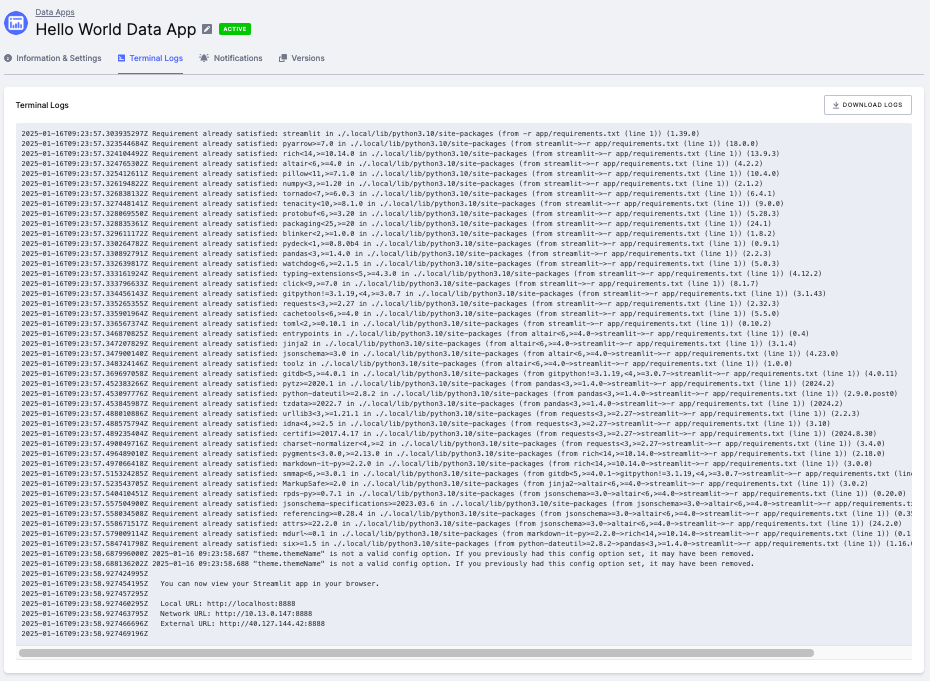
- Near real-time log display — terminal output as it is generated, with a short delay.
- Full log download — download the complete log from the app’s start with Download Logs.
- Log availability — logs are accessible only while the app is running, and are deleted when it stops or pauses.
App actions
Section titled “App actions”Manage a deployed app from its actions menu.
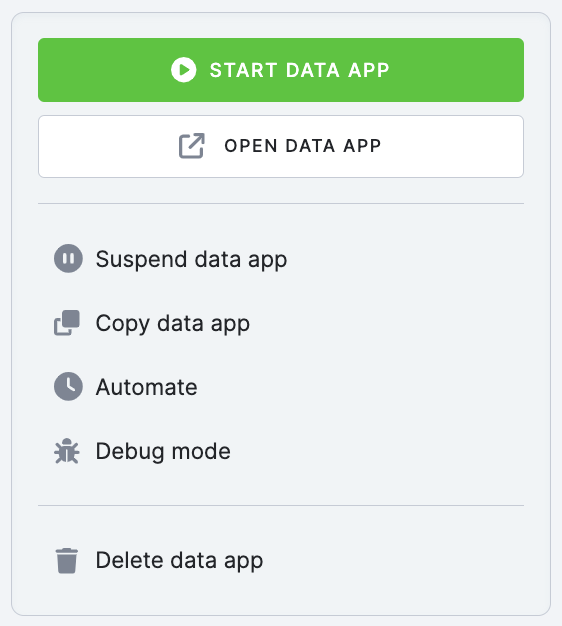
- Deploy App — starts the app. Once the deployment job finishes, open the app’s public URL with Open App.
- Open App — opens a new window with your app.
- Redeploy — apply changes made in the app configuration (they take effect only after a redeploy).
- Suspend App — stops the app. The container stops and the URL is no longer available, but the configuration is kept.
- Delete App — stops the deployment and deletes its configuration.
Sleep and resume
Section titled “Sleep and resume”The Suspend/Resume feature saves resources by putting your app to sleep after a period of inactivity.
- Activity monitoring — the app watches for HTTP requests and active WebSocket connections. If none occur for the configured period, it suspends. An inactive browser tab can still cause background activity; Chrome’s Memory Saver can help prevent this.
- Automatic resumption — the next request wakes the app. The first request after waking may take slightly longer.
- Cost efficiency — you’re billed only for the time the app was active or waiting to suspend.
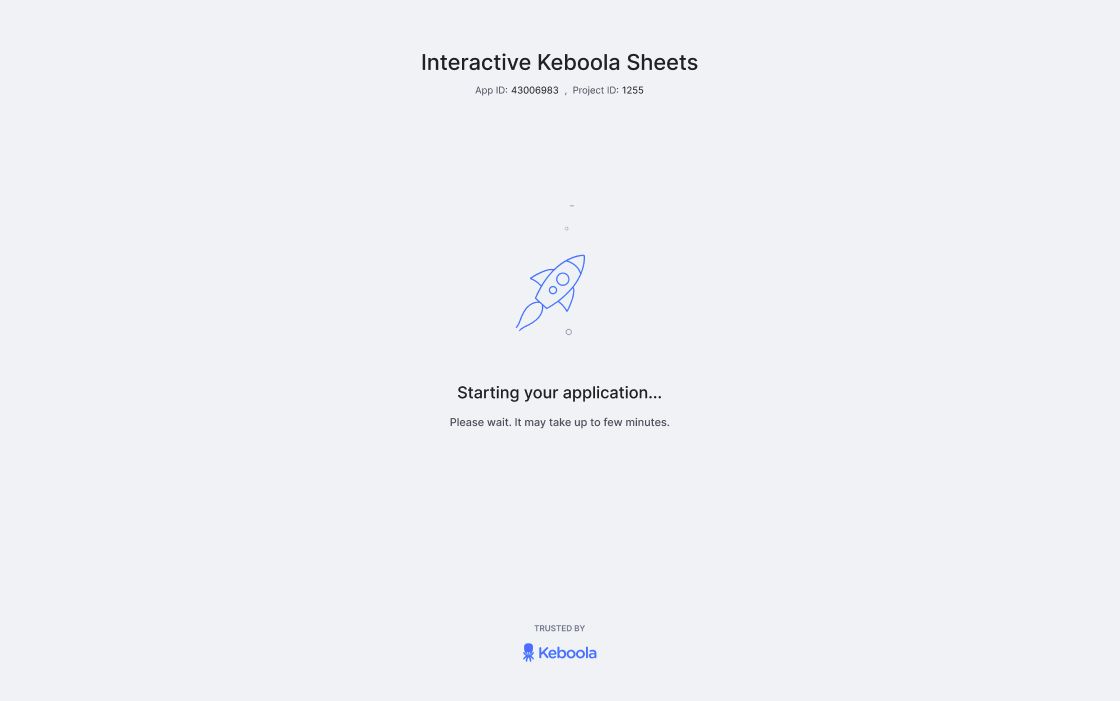
If you open the URL of a sleeping app, it triggers wakeup and shows a waking up page.
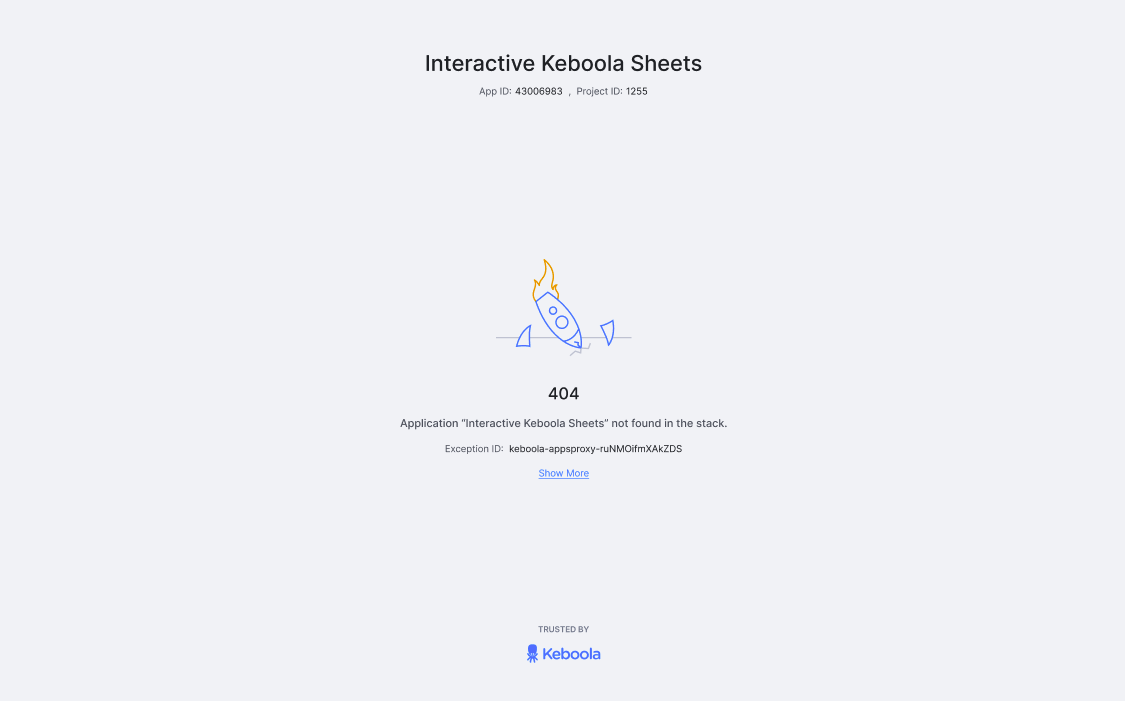
If something goes wrong, a wakeup error page appears; click Show More for details.
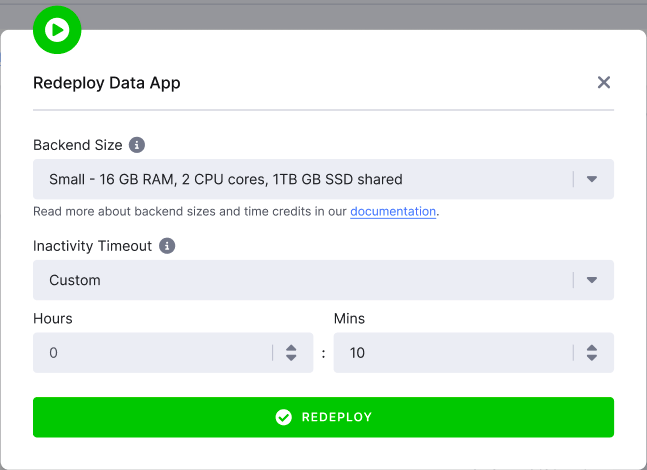
When you Deploy or Redeploy, a wizard prompts for the backend size and the auto-sleep timeout (five minutes to 24 hours; default five minutes).
Debugging app deployment
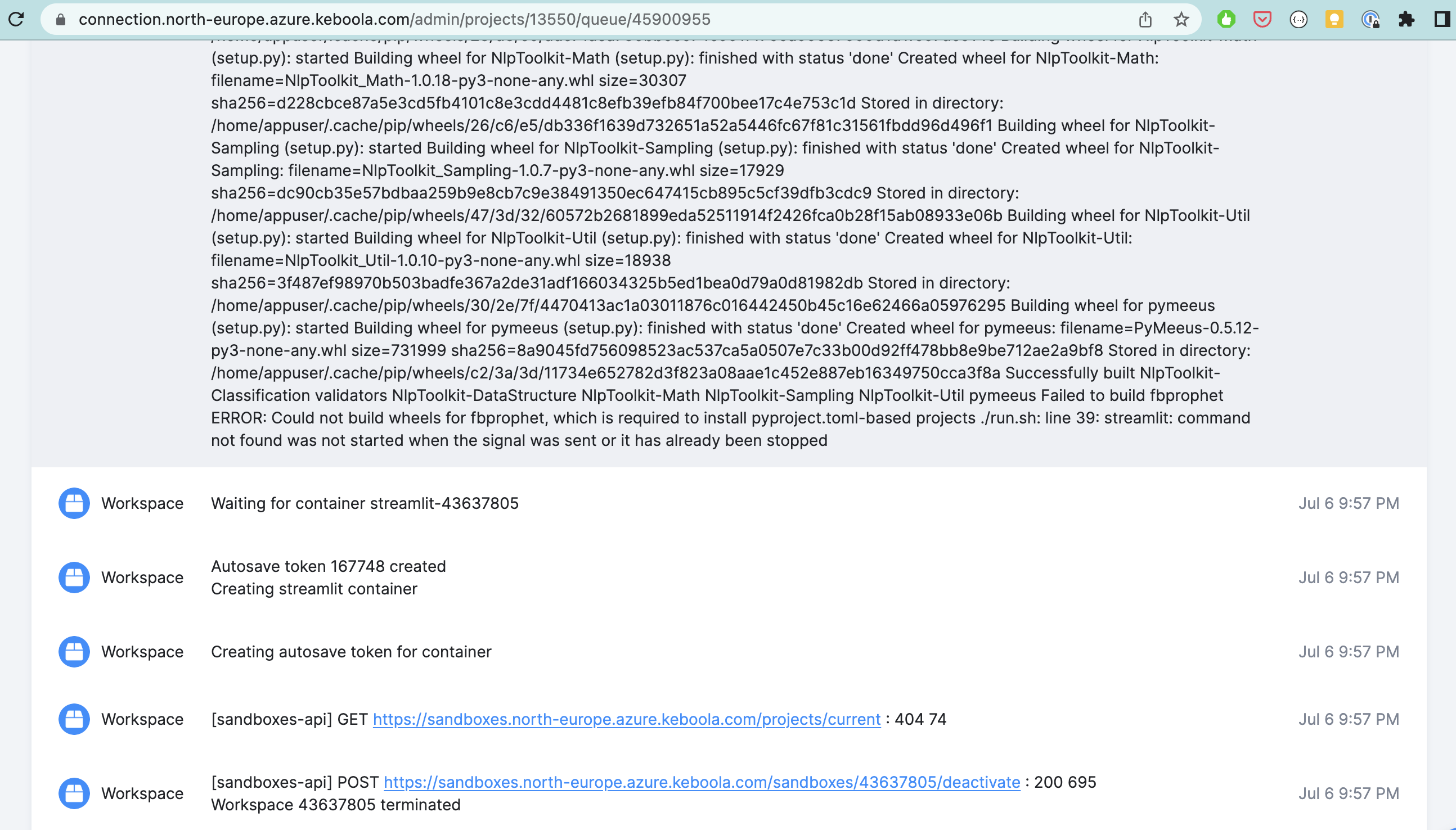
Section titled “Debugging app deployment”If the app deployment job fails, you can see the logs from its container in the event log of the deployment job. For example, there may be a conflict with the specified packages:
Limits
Section titled “Limits”Storage Access has the following limitations:
- Snowflake only — Storage Access currently works only with Snowflake backends. BigQuery support is planned for a future release.
- Column-level permissions not supported — granting access to a table grants read/write on all its columns.
- Permission changes require app restart — adding or removing tables takes effect on the next app start (deploy, redeploy, or wake from sleep).